Clicking Objects
How can I make it so players can click on objects in the game to interact with them?
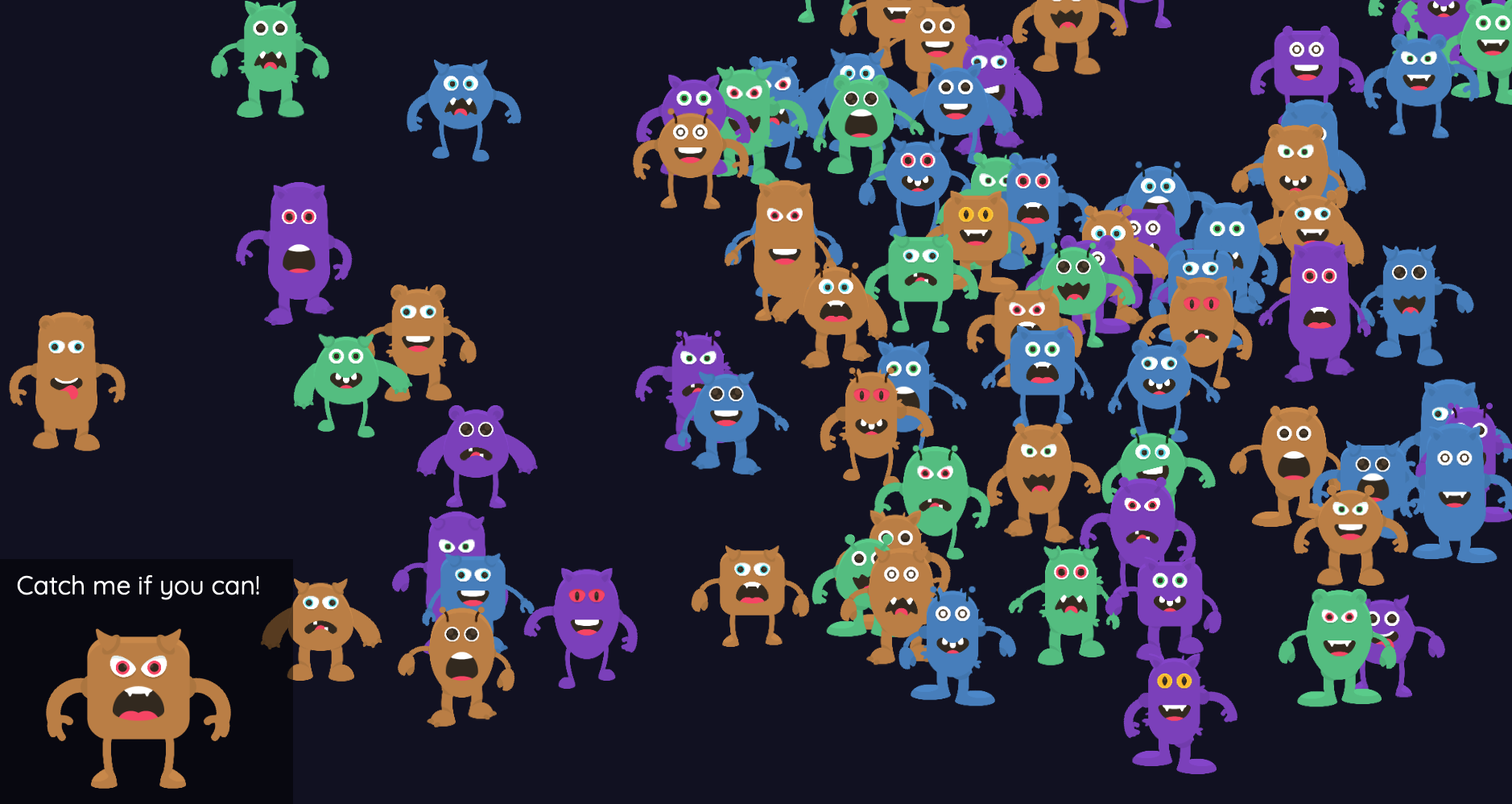
This is an example of "Where's Waldo?" style game where you need to find the right monster in a crowd of monsters. This will be a multiplayer game, so players will be racing to be the first to click on the target monster. We will use hotspots to make the monsters clickable. When the player hovers over a monster, the monster will be highlighted to show that it is clickable.
This example is for clicking on objects in the game world. This may be more complicated than you need. If you simply want to respond to clicks but not at any particular object, you can simply use ButtonDown:
on ButtonDown(Click) {
    Print { "Hello, world!" }
}
The Bots and Mobs examples both show you how you can fire projectiles by clicking. They may be a more appropriate example depending on what you are trying to achieve.
Step 1: Create some monsters to click on
Each round of our game will have 101 monsters - 100 "decoy" monsters and 1 "target" monster that the player is trying to find.
Step 1a: Create a crowd of monsters
First we need to spawn our 100 decoy monsters. Each monster will have a random position and random appearance.
await fn CatchMonsterRound() {
    await Spawn round {
        // ...

        // Create the sea of monsters
        repeat 100 {
            Subspawn unit {
                Monster(
                    pos=@(SignedRandom * BoundaryHalfWidth, SignedRandom * BoundaryHalfHeight),
                    color=PickRandom(roundColors),
                    arm=PickRandom(@arm-*.png), chest=PickRandom(@chest-*.png), eye=PickRandom(@eye-*.png),
                    horn=PickRandom(@horn-*.png), leg=PickRandom(@leg-*.png), mouth=PickRandom(@mouth-*.png),
                )
                WanderingSystem
                CatchMeSystem
            }
        }

        // ...
    }
}
Step 1b: Create the target monster
Now, we need to spawn our target monster.
This monster will have a random position and random appearance, just like the decoy monsters,
but it will have a special property IsTargetMonster set to true so we can identify it later.
await fn CatchMonsterRound() {
    await Spawn round {
        // ...

        // Create the target monster
        let color=PickRandom(roundColors)
        let arm=PickRandom(@arm-*.png), chest=PickRandom(@chest-*.png), eye=PickRandom(@eye-*.png)
        let horn=PickRandom(@horn-*.png), leg=PickRandom(@leg-*.png), mouth=PickRandom(@mouth-*.png)
        Subspawn unit {
            IsTargetMonster = true
            Monster(
                pos=@(SignedRandom * BoundaryHalfWidth, SignedRandom * BoundaryHalfHeight),
                color=, arm=, chest=, eye=, horn=, leg=, mouth=,
            )
            WanderingSystem
            CatchMeSystem
        }

        // ...
    }
}
Step 2: Clicking on monsters
Step 2a: Make them clickable
To make our monsters clickable, we need to add a PolygonHotspot to each monster:
pub fn unit.CatchMeSystem([round]) {
    use body=this, radius=1
    use shape=Rectangle(width=2*radius, height=3*radius)

    PolygonHotspot(PressIntent<touchedMonster>)
    PolygonCollider(category=Category:Monster, collideWith=Category:None)
}
A PolygonHotspot requires an intent to tell it what to do when the hotspot is clicked on.
In this case, we will give it a PressIntent with the ID <touchedMonster>
which will let us handle the click in the next step.
Because we will receive the same Pressed<touchedMonster> event regardless of which of the 101 monsters was clicked,
we are also adding a PolygonCollider here so that we can quickly find the monster
that was underneath the pointer when a click occurs.
As this is our only purpose for the PolygonCollider in this example,
we set collideWith=Category:None to stop the monsters from colliding with each other and pushing each other around.
Step 2b: Handle clicks
This is a multiplayer game, and so each player will handle their own clicks on the monsters:
pub fn owner.CatchingSystem() {
    on Pressed<touchedMonster> {
        let unit = Pointer.QueryNearest(filter=Category:Monster)
        if !unit { continue }

        if unit.IsTargetMonster {
            MonsterCaughtBy(owner)
        } else {
            TextSpark(
                "Not me!", fontSize=1, bold=true, layer=1,
                body=Pointer, screenOffset=@(0, -1), velocity=@(0, -1),
                taper=0, fade=1, dissipate=1s,
            )
        }
    }
}
When a click event is received, we will query for the nearest monster to the pointer position to determine which monster the player clicked on.
- If the player clicked on the target monster, we will send a
MonsterCaughtBysignal to the whole world to say that the monster has been caught by that player. This will be handled in the next step to end the round. - If the player clicked on a decoy monster, we will show "Not me!" so the player knows they clicked on the wrong monster.
In a multiplayer game, objects may be spawned and despawned in different sequences for different players,
and so it is not reliable to send an ID identifying which object was clicked on.
It is better to send a PressIntent that says "the player clicked on an object, but we don't know which one"
and then use the pointer position to find the nearest object to the click.
That is what we are doing here with QueryNearest.
Step 3: Win condition
The round will be waiting for a MonsterCaughtBy signal to be sent by one of the players.
Once it receives that signal, the round is over.
We will display a game over dialog for 5 seconds before ending the round.
await fn CatchMonsterRound() {
    await Spawn round {
        let start = Tick

        // ...

        // Wait for someone to find the target
        let winner = await MonsterCaughtBy
        MonsterCaught = true
        GameOverDialog(catchDuration=(Tick - start), winner=)
        await Tick(5s)
        Expire
    }
}
Full Code Listing
Thanks to Kenney for the monster art used in this example!
pub const BoundaryHalfWidth = 32
pub const BoundaryHalfHeight = 18

pub tangible category Category:Monster
pub const MonsterColors = [#c44, #c84, #4c8, #48c, #84c]
pub const ChestAspectRatios = {
    @chest-1.png = 1,
    @chest-2.png = 1,
    @chest-3.png = 0.72,
    @chest-4.png = 0.95,
    @chest-5.png = 0.55,
    @chest-6.png = 0.72,
}

pub signal World.MonsterCaughtBy(owner)

pub prop unit.IsTargetMonster = false
pub prop round.MonsterCaught = false

pub game fn World.Main(maxHumanPlayers=5) {
    Camera(@(0, 0), radius=@(BoundaryHalfWidth, BoundaryHalfHeight))
    SolidBackground(#112)

    SpawnEachPlayer owner {
        CatchingSystem
    }

    loop {
        await CatchMonsterRound
    }
}

await fn CatchMonsterRound() {
    await Spawn round {
        let start = Tick

        // Choose how many colors we will have this round
        let numRoundColors = Floor(1 + Random * MonsterColors.Length).Max(2)
        let roundColors = Shuffle(MonsterColors.ToArray).Slice(0, numRoundColors)

        // Create the sea of monsters
        repeat 100 {
            Subspawn unit {
                Monster(
                    pos=@(SignedRandom * BoundaryHalfWidth, SignedRandom * BoundaryHalfHeight),
                    color=PickRandom(roundColors),
                    arm=PickRandom(@arm-*.png), chest=PickRandom(@chest-*.png), eye=PickRandom(@eye-*.png),
                    horn=PickRandom(@horn-*.png), leg=PickRandom(@leg-*.png), mouth=PickRandom(@mouth-*.png),
                )
                WanderingSystem
                CatchMeSystem
            }
        }

        // Create the target monster
        let color=PickRandom(roundColors)
        let arm=PickRandom(@arm-*.png), chest=PickRandom(@chest-*.png), eye=PickRandom(@eye-*.png)
        let horn=PickRandom(@horn-*.png), leg=PickRandom(@leg-*.png), mouth=PickRandom(@mouth-*.png)
        Subspawn unit {
            IsTargetMonster = true
            Monster(
                pos=@(SignedRandom * BoundaryHalfWidth, SignedRandom * BoundaryHalfHeight),
                color=, arm=, chest=, eye=, horn=, leg=, mouth=,
            )
            WanderingSystem
            CatchMeSystem
        }

        // Display the target monster in a special camera
        let exampleCamera = Subspawn camera {
            Camera(@(0, 0), radius=2.5)
            SolidBackground(#0008)
            TextSprite("Catch me if you can!", body=@(0, -2), fontSize=1)

            Viewport<profile>(width=12, height=10, anchor=@(-1, 1))
            await MonsterCaught
            Viewport<profile>(scale=0) // hide the camera once monster has been caught
        }
        Subspawn unit {
            Monster(
                pos=@(0, 0),
                color=, arm=, chest=, eye=, horn=, leg=, mouth=,
                camera=exampleCamera,
            )
        }

        // Wait for someone to find the target
        let winner = await MonsterCaughtBy
        MonsterCaught = true
        GameOverDialog(catchDuration=(Tick - start), winner=)
        await Tick(5s)
        Expire
    }
}

fn this.GameOverDialog(catchDuration, winner) {
    BottomContent {
        InsetPanel {
            P(fontSize=1.5) {
                PlayerNameDisplay(winner)
                " caught the monster in "
                Span(bold=true, color=#e8f) {
                    %((catchDuration / 1s).FormatWithDecimals(1) + "s")
                }
            }
        }
    }
}

pub prop unit.StrideProportion = 0 // a value between -1 and 1 to animate
pub fn unit.Monster(pos, color, arm, chest, eye, horn, leg, mouth, radius=1, [camera?]) {
    use body=this
    let aspectRatio = ChestAspectRatios[chest] ?? 1

    let armOffset = @(0.7 * radius, 0)
    let armRadius = 0.75 * radius
    let armAngle = -0.1rev

    let legOffset = @(0.6 * radius, 0.6 * radius / aspectRatio)
    let legRadius = 0.75 * radius

    let hornOffset = @(0.4 * radius, -0.7 * radius / aspectRatio)
    let hornRadius = 0.25 * radius

    let mouthOffset = @(0, 0.3 * radius / aspectRatio)
    let mouthRadius = 0.5 * radius

    let eyeOffset = @(0.3 * radius, -0.4 * radius / aspectRatio)
    let eyeRadius = 0.25 * radius

    Body(pos=, noRotation=true)

    with StrideProportion p {
        let armRotate = 0.05rev * p
        let legShift = @(0, 0.1 * p * radius / aspectRatio)

        ImageSprite(image=arm, bodyOffset=armOffset, radius=armRadius, angleOffset=armAngle-armRotate, imageAnchor=@(-0.8, -0.8), color=)
        ImageSprite(image=arm, bodyOffset=armOffset, radius=armRadius, angleOffset=armAngle+armRotate, imageAnchor=@(-0.8, -0.8), color=, bodyScale=@(-1, 1))

        ImageSprite(image=leg, bodyOffset=legOffset + legShift, radius=legRadius, imageAnchor=@(0, -0.8), color=)
        ImageSprite(image=leg, bodyOffset=legOffset - legShift, radius=legRadius, imageAnchor=@(0, -0.8), color=, bodyScale=@(-1, 1))
    }

    ImageSprite(image=chest, color=, radius=radius/aspectRatio)

    ImageSprite(image=horn, bodyOffset=hornOffset, radius=hornRadius, imageAnchor=@(-0.8, 0.8), color=)
    ImageSprite(image=horn, bodyOffset=hornOffset, radius=hornRadius, imageAnchor=@(-0.8, 0.8), color=, bodyScale=@(-1, 1))

    ImageSprite(image=mouth, bodyOffset=mouthOffset, radius=mouthRadius)

    ImageSprite(image=eye, bodyOffset=eyeOffset, radius=eyeRadius)
    ImageSprite(image=eye, bodyOffset=eyeOffset, radius=eyeRadius, bodyScale=@(-1, 1))
}

pub fn unit.WanderingSystem {
    use body=this
    on BeforePhysics(2s * Random) {
        let target = @(SignedRandom * BoundaryHalfWidth, SignedRandom * BoundaryHalfHeight)
        let speedFactor = 0.75 + Random * 0.75
        let start = Tick
        let strideInterval = 1s * speedFactor
        loop {
            let diff = target - Pos
            if diff.Length < 1 { break }

            StrideProportion = Sin(2 * Pi * ((Tick - start) / strideInterval))
            Move(0.03 * diff.Direction)
            await BeforePhysics
        }
    }
}

pub fn unit.CatchMeSystem([round]) {
    use body=this, radius=1
    use shape=Rectangle(width=2*radius, height=3*radius)

    PolygonHotspot(PressIntent<touchedMonster>)
    PolygonCollider(category=Category:Monster, collideWith=Category:None)

    once MonsterCaught {
        if IsTargetMonster {
            Strobe(growth=1, shine=0.5, dissipate=0.5s)
            TextSprite<speech>("You got me!", screenOffset=@(0, -2.5*radius), fontSize=1, bold=true, strobe=false, layer=1)
        } else {
            await Tick(1s * Random)
            Expire
        }
    }
}

pub fn owner.CatchingSystem() {
    on Pressed<touchedMonster> {
        let unit = Pointer.QueryNearest(filter=Category:Monster)
        if !unit { continue }

        if unit.IsTargetMonster {
            MonsterCaughtBy(owner)
        } else {
            TextSpark(
                "Not me!", fontSize=1, bold=true, layer=1,
                body=Pointer, screenOffset=@(0, -1), velocity=@(0, -1),
                taper=0, fade=1, dissipate=1s,
            )
        }
    }
}